
Fashion Operating System
One system for the whole garment factory.
From the cutting table to the tax invoice. Lots, job work, piece-rate wages, stock and GST — with the worker desks in Hindi, on the phone already in your supervisor's pocket.
No signup. Six real desks, loaded with a complete worked example of a factory's month.
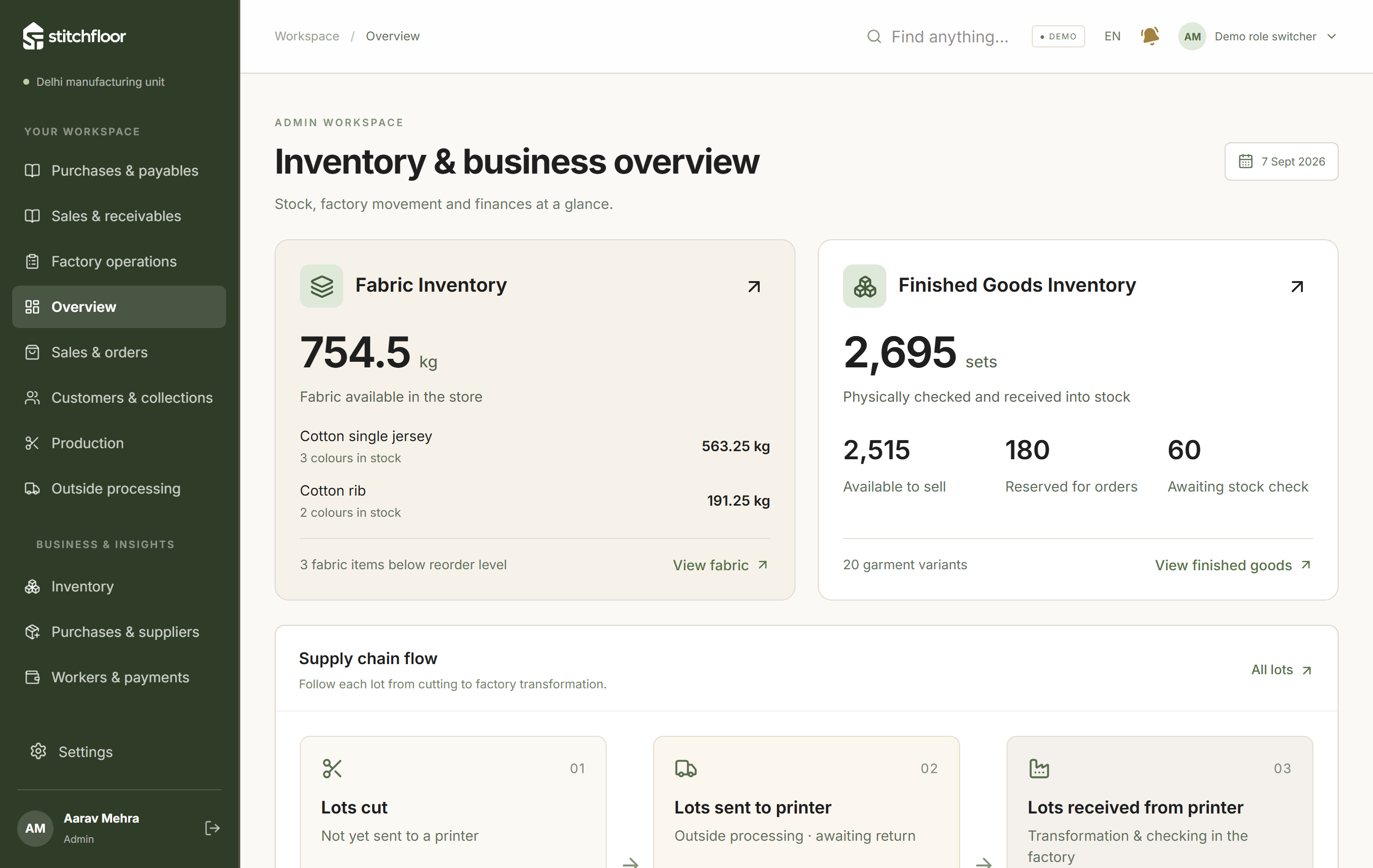
- Six desks, one record Admin, production, operations, sales, purchase, inventory
- Hindi on the worker desks Menus, forms, dialogs and confirmations — not just the nav
- Spoken prompts A speaker button reads the heading out: Hindi, then English
- GST-ready documents HSN, CGST/SGST/IGST, invoice series and customer statements
Where is LOT-244?
In most units that question costs three phone calls, because the answer is written down in four places and none of them agree.
The lot went out to the printer on a piece of paper nobody kept a copy of.
The tailor's count is in a notebook, in handwriting, settled on Saturday.
The shortage was reported in a group chat that has since scrolled past it.
And the invoice exists in software the floor has never once opened.
Six desks. One set of records underneath.
Everyone signs in to their own desk and works in their own screens — but they are all writing to the same books, so a lot received on the floor is a lot the accounts already know about.
Production supervisor
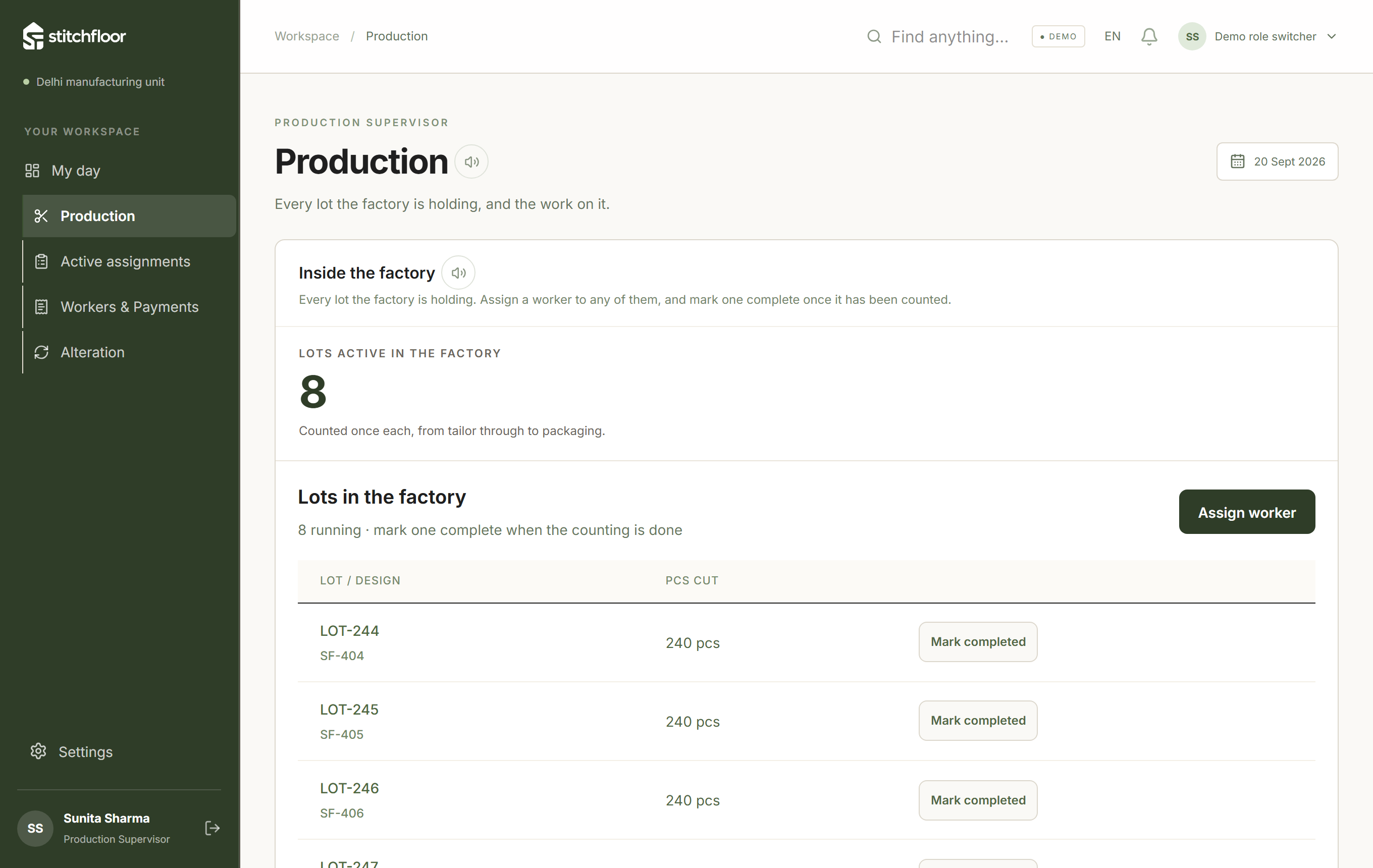
What the floor is holding, and who is working on it.
- Every lot the factory is holding, and the work recorded against it
- Assign a worker to a bundle, with the rate prefilled and editable
- An assignment closes itself when its last piece comes back
- Weekly job cards, printed one at a time or in bulk
Operations supervisor
The work that happens outside the factory walls.
- Lots sent to a printer, and counted on the way back
- A categorised factory cash book
- The shared alteration register
Inventory manager
Fabric in, garments out, and the packing in between.
- Fabric stock by weight, broken down colour by colour
- Final designs assigned, packaging confirmed or released
- Finished goods checked in, dispatched and returned
- Confirmed packing adds finished stock exactly once
Sales & receivables
Orders, invoices, and the money still to come.
- Multiple invoice series with signed-slip tracking
- Payments, reminder drafts and ageing
- Customer statements with separate invoice and receipt cutoffs
Purchase & payables
Suppliers, printers and everyone else you owe.
- Supplier orders and counted receipts into raw stock
- Supplier, printer and other-creditor bills
- Statements per creditor, with independent cutoff dates
Admin
The whole business on one screen, and the overrides.
- Fabric and finished stock at a glance
- Lots cut, out at a printer, and back in the factory
- Receivables, payables and supply alerts
- Approvals, costing and accounts
Built for the person on the floor.
Most factory software is written for the office and then handed down. The supervisor who actually has to record the work is the last person it was designed for — so they keep the register instead, and the software stays a month behind.
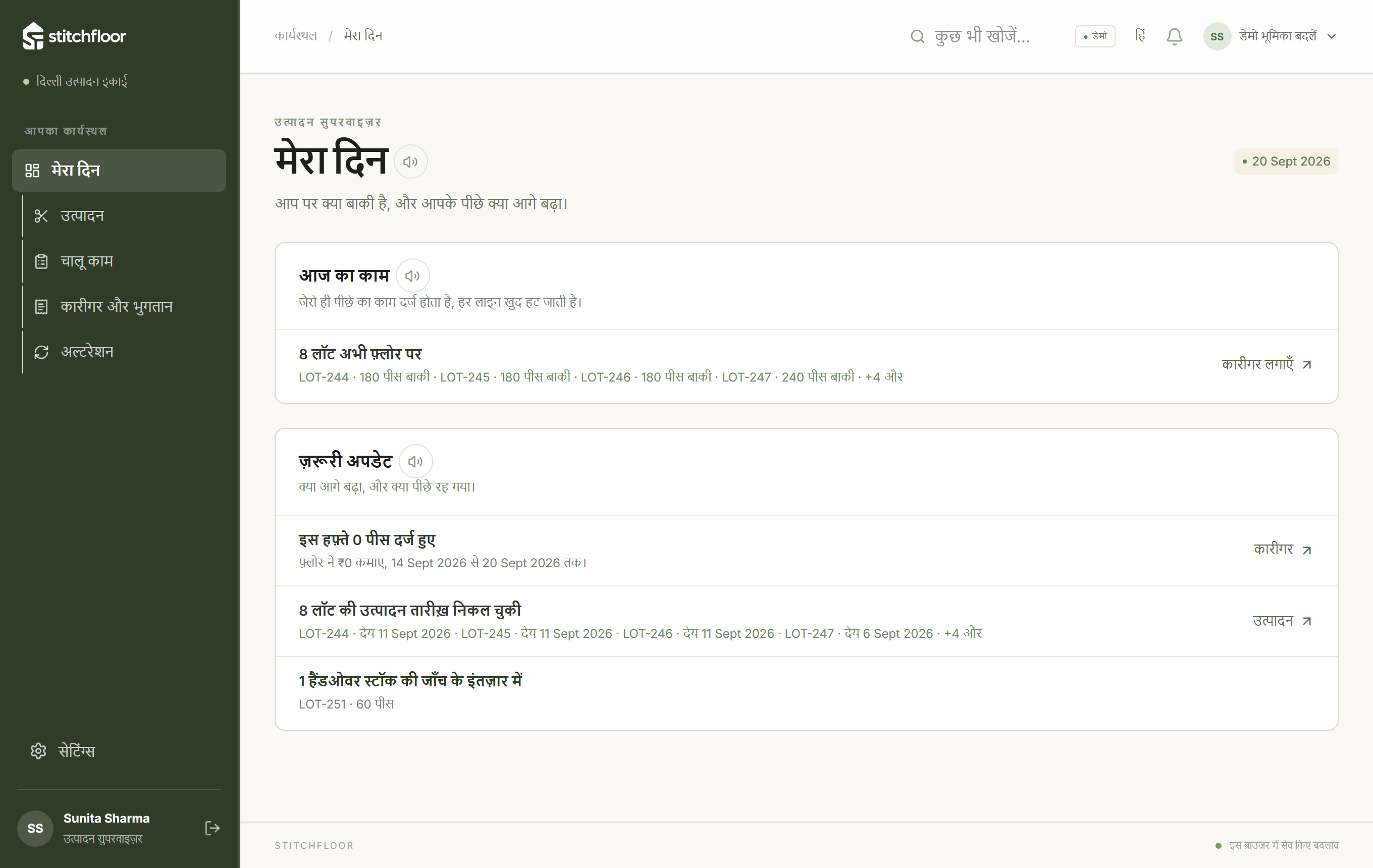
- Hindi is a mode, not a menu One toggle puts the worker desks into Hindi: the menus, the screens they work from and the forms they record work in. Your own records — names, lot numbers, rupee figures — stay exactly as they were entered, because they have to match the job card. The printed documents are still English, and so is every validation message a form refuses with.
- A speaker button where the work is recorded Press it and the screen reads its heading out, in Hindi first and then English — 43 recorded instructions across the worker desks' main screens and about a third of their forms. Written for someone who reads slowly, not for someone who cannot read at all.
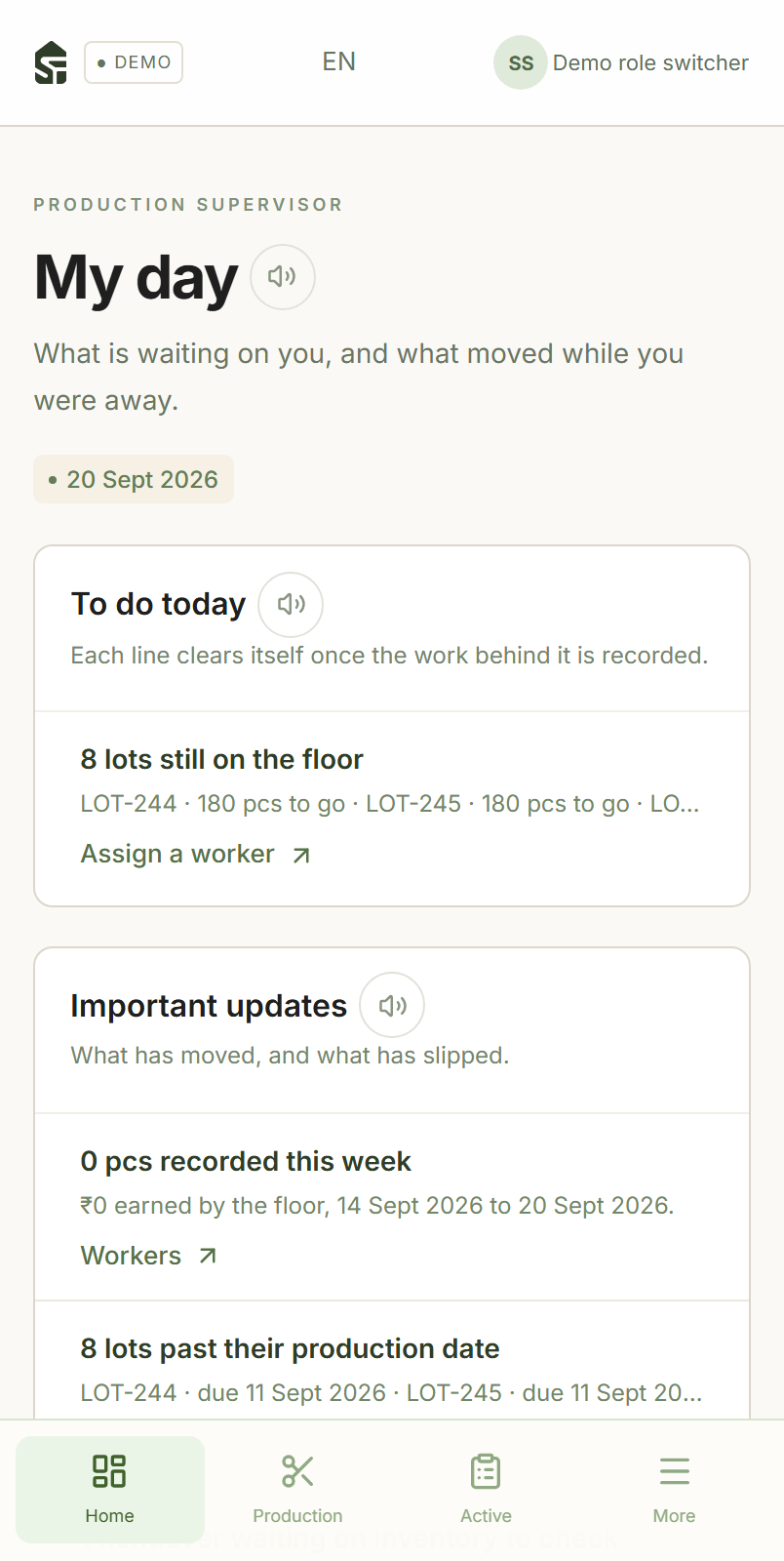
- It fits the phone they already have The same desk, on a 5-inch screen, with targets big enough for hands that have been working all day.
What you are probably using now.
Written to be argued with. Accounting software and the big ERPs are good at what they are for — this table is about a garment factory's floor, which is not what either was built for.
| Capability | Registers & WhatsApp | Accounting software | General-purpose ERP | Stitchfloor |
|---|---|---|---|---|
| Who actually uses it | Everyone, on paper | The accountant | The office, after training | Six desks, including the floor |
| Hindi | Yes — it is handwritten | Rarely, and partially | Sometimes, at a price | Every worker desk, down to the dialogs |
| Spoken instructions | A supervisor, explaining again | No | No | A speaker button on the worker screens |
| A lot out at a printer | A slip, and a phone call | Not modelled | Configurable, as a project | Sent, tracked and counted back in |
| Piece-rate wages and job cards | A register, settled on Saturday | Payroll only | An add-on module | Rates per process, earned when the bundle goes out |
| GST invoices | Typed out by hand | Yes — this is its strength | Yes | Printed from the record the floor updated |
| Confirming a packing twice | Two different answers | A duplicate entry | Depends on the setup | Adds the finished stock exactly once |
| Getting started | — | Days | Months, and a consultant | Open the demo and use it today |
The Stitchfloor column is meant to be checked, not taken on trust: open the demo, send a lot to a printer, receive it short, and print the job card it produces.
Trusted with the books, not just the to-do list.
A factory system that loses a bundle is an inconvenience. One that pays a worker twice is a different kind of problem.
- Every action is one transaction Validated before it posts, and written as a unit — a confirmation that is interrupted halfway does not leave the stock moved and the wage unrecorded.
- Recorded work keeps its own numbers Changing a process rate today does not re-price the work already recorded against the old one, and a new design variant does not rename a garment that has already been invoiced.
- Access control is real, and the demo is not it A live workspace signs in against Firebase with a required second factor for administrators, and each role's database rules are generated from the app's own permission map rather than written by hand beside it. The public demo has neither — one shared password and this browser's storage, which is why you can take it apart without asking anyone.
Who is building it.
Two people, close enough to a real floor to keep getting told when they are wrong.
Aditya Doomra
Co-founder
Works in corporate finance and strategy at Bain & Company, on applying machine learning to financial and strategic problems. Studied commerce at Sri Venkateswara College, Delhi University, and machine learning and AI at Univ.AI. At Stitchfloor he owns the question of what a number on a screen has to mean before anybody should act on it.
Ridhav Jain
Co-founder
Builds the product — the six desks, the Hindi mode and the ledger underneath them. He works against a real factory rather than a specification, which is why Stitchfloor models a lot going out to a printer and coming back short, instead of a generic work order.
Stitchfloor was designed on a working floor, not in a workshop. It is built alongside a garment manufacturer running it for real — every screen here started as a question somebody there actually had to answer that morning.
Open it. It is the real thing.
The demo is the product, loaded with a complete worked example of a factory's month. Sign in as a production supervisor and assign a worker to a lot — it takes about a minute, and nothing you do there touches anyone else.
demo.stitchfloor.com — sign in as
production.demo with the password
Stitchfloor@123. The other five desks are behind
View demo logins on the sign-in screen.